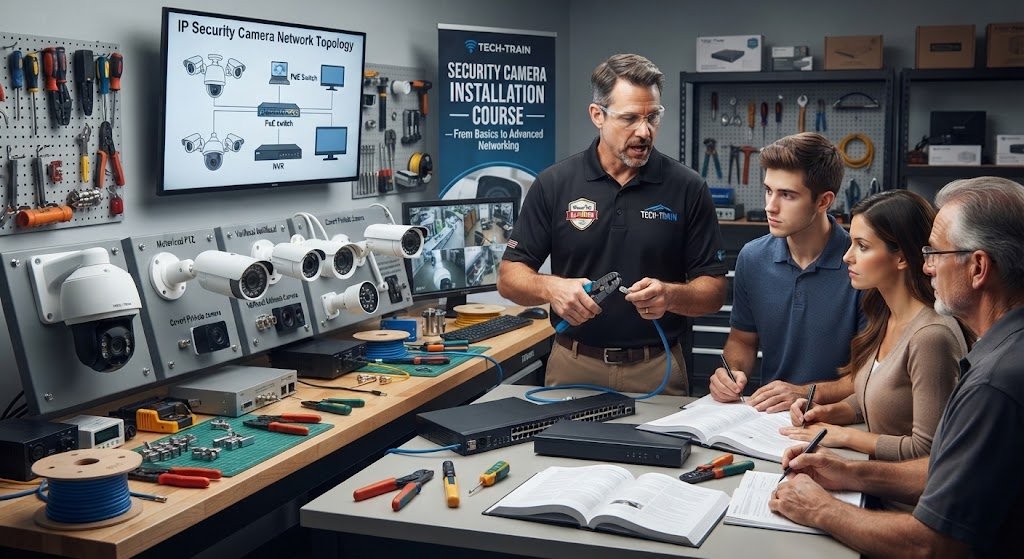
The world of security camera installation has changed more in the last five years than in the previous two decades. The industry has moved decisively away from analogue CCTV systems toward networked IP surveillance — cameras that communicate over data networks, record to network video recorders, stream in ultra-high definition, and integrate with access control, alarm systems, and cloud-based remote monitoring platforms. The technician who understands only how to mount a dome camera and connect it to a DVR is already falling behind the standard that commercial clients, facility managers, and serious property owners expect from a professional security camera installer.
The security camera installation course offered by MindGigs is designed for the learner who wants to enter this field at the level the modern market demands — with genuine understanding of how today's surveillance systems actually work, from the physical camera and its lens through the structured cabling network and PoE switch to the NVR, the cloud storage integration, and the remote monitoring application on the client's smartphone. This is not a course about doing the minimum. It is a course about doing it properly — from the start.
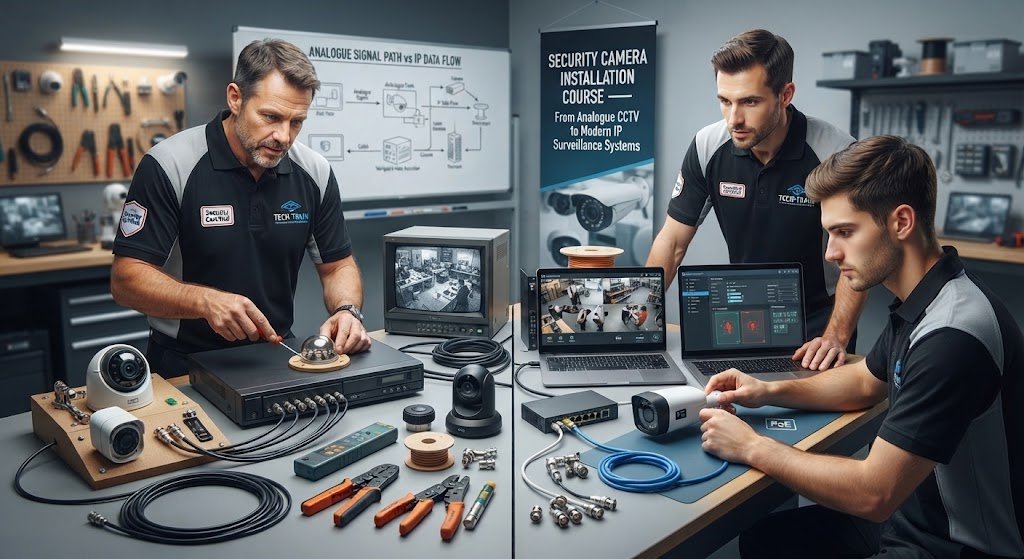
There is a persistent misconception in Pakistan's security installation market that installing a modern IP camera system is essentially the same as installing an older analogue CCTV system — just with different cables. This misconception produces systems that work partially, fail intermittently, lose remote access without explanation, deliver disappointing footage quality, or cannot be scaled when the client wants to add cameras later.
IP surveillance systems are fundamentally different from analogue CCTV in their architecture, their configuration requirements, and their failure modes. Understanding why requires looking at what actually changed.
An analogue CCTV camera converts light to an electrical signal and sends that signal directly down a coaxial cable to a DVR, which records it. The technical complexity is low. The resolution ceiling is fixed and relatively limited. The cabling is straightforward. The configuration is minimal.
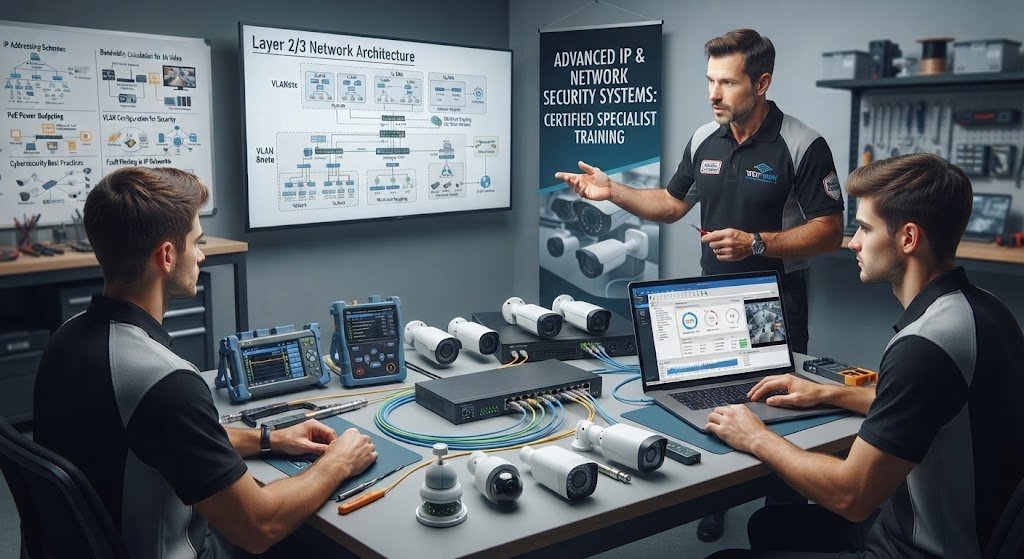
This course is most productive for learners who bring at least one of the following to the table — an existing technical background, prior exposure to basic CCTV concepts, or a strong motivation to engage seriously with networking principles alongside physical installation skills.
who want to extend their competence into physical security infrastructure. The network configuration elements of this course will feel familiar — the course focuses on applying that existing knowledge to the specific requirements of IP surveillance architecture rather than teaching networking from scratch.
who have been working with analogue systems and want to formally develop their IP camera and NVR competence to keep pace with what commercial clients now specify. Many analogue-era technicians have picked up fragments of IP knowledge on the job — this course provides the structured, complete understanding that fills the gaps and builds genuine confidence in the IP domain.
who want to move into the security technology sector. Cat6 termination, cable routing, and conduit work are already familiar — this course focuses on the network configuration, camera setup, and system commissioning that transforms those physical skills into a complete security installation capability.
in electronics, electrical engineering, or telecommunications who want a focused professional qualification in security camera systems before entering the job market.
The MindGigs security camera installation course is structured in eight modules that build from foundational security camera concepts through to advanced IP system configuration, enterprise integration, and professional project delivery.
The evolution of surveillance technology — from analogue CCTV to HD-CVI, HD-TVI, AHD, and full IP networks. Understanding why the market has moved toward IP and what this means for the skills a professional installer must carry. Overview of system architectures — standalone NVR systems, hybrid DVR/IP systems, cloud-managed camera platforms, and enterprise VMS (Video Management Software) deployments. Introduction to the major manufacturer ecosystems — Hikvision, Dahua, Axis, and others — and understanding their relative positioning in Pakistan's commercial market.
Detailed technical understanding of fixed dome cameras, bullet cameras, turret cameras, PTZ cameras, multi-sensor cameras, and fisheye cameras — their mechanical design, their optical characteristics, and the specific applications each type is best suited to. Understanding lens specifications — focal length, angle of view, depth of field, and varifocal versus fixed lens selection. Sensor size and its effect on low-light performance. WDR (Wide Dynamic Range) — why it matters for cameras covering areas with mixed bright and dark zones such as entrance lobbies and car parks. H.265+ compression — how it reduces storage and bandwidth requirements compared to H.264, and how to specify compression settings for different deployment scenarios.
Cat6 cable specification and selection for PoE camera installations. Understanding PoE standards — IEEE 802.3af (15.4W), IEEE 802.3at (30W), and IEEE 802.3bt (90W) — and how to match PoE budget to camera power requirements. Maximum cable run lengths for PoE and how to extend them using PoE extenders when site layout requires it. Structured cabling installation — routing, dressing, and labelling for professional, serviceable infrastructure. Patch panel and wall plate termination for installation in buildings with existing structured cabling infrastructure. Cable testing — using a cable tester and PoE tester to verify each run before camera mounting.
Understanding IP addressing — IPv4 address structure, subnet masks, default gateways, and how cameras are assigned addresses within a local network. Static IP assignment versus DHCP — when to use each and the specific advantages of static addresses for surveillance infrastructure. Accessing camera web interfaces — logging in to an IP camera's configuration page using a browser, navigating manufacturer-specific interfaces, and setting essential parameters including IP address, resolution, frame rate, codec, and bitrate. ONVIF protocol — what it is, why it matters for multi-brand installations, and how to verify ONVIF compatibility between cameras and NVRs. PoE switch configuration — understanding managed versus unmanaged switches, VLAN setup for network isolation of camera traffic, and QoS (Quality of Service) configuration to prioritise surveillance data.
NVR hardware installation — rack-mounted versus desktop NVRs, hard drive installation, and initial power-on procedures. Camera discovery and channel assignment — automatic discovery via ONVIF, manual IP entry, and channel capacity management. Recording profile configuration — continuous recording, motion-triggered recording, schedule-based recording, and alarm-linked recording. Storage sizing — calculating required HDD capacity based on camera count, resolution, frame rate, compression codec, and retention period. RAID configuration basics — understanding RAID 1 and RAID 5 on NVRs that support them, and when to recommend them for mission-critical installations. NVR user account management — creating administrator, operator, and viewer accounts with appropriate permission levels.
Port forwarding configuration on routers — step-by-step for the router models most commonly encountered in Pakistan's residential and commercial deployments. DDNS setup and management — configuring dynamic DNS for systems on dynamic ISP-assigned IP addresses. Manufacturer P2P (Peer-to-Peer) cloud access — how it works, its advantages for client convenience, and its limitations compared to properly configured port forwarding. Mobile application configuration — setting up live view, playback, and push notification on iOS and Android for major NVR brands. VMS (Video Management Software) — introduction to PC-based video management platforms for multi-site enterprise deployments where a single NVR interface is insufficient.
PTZ camera installation — mounting, cable routing for RS-485 control alongside Cat6 data cabling, and mechanical adjustment. PTZ control configuration in NVR and VMS interfaces — protocol selection, address assignment, and testing. Preset programming — setting and naming camera positions for fast operator navigation. Auto-patrol configuration — programming PTZ cameras to cycle through preset positions automatically at defined intervals. Introduction to camera-based video analytics — motion detection zones, line crossing detection, intrusion detection, and face detection features available on current mainstream IP cameras. Understanding the practical limitations of analytics in real-world deployment conditions
Integration with access control systems — understanding how IP cameras and access control panels connect through a VMS or through direct alarm input/output wiring. Integration with intruder alarm systems — camera alarm input triggering, alarm-linked recording activation, and alarm notification configuration. Site survey and documentation — producing a professional survey report, camera placement plan with coverage diagrams, cabling schedule, equipment list, and project cost estimate. Installation project management — scheduling, material procurement, site access coordination, and commissioning sequence. Client handover — system walkthrough, user training, handover documentation, and maintenance contract discussion. Professional practice — communication standards, site presentation, invoicing, and building a professional reputation in Pakistan's security installation market.
Unlike courses that assess learning through written examinations alone, the MindGigs security camera installation course is assessed primarily through practical demonstration — because installation is a practical skill, and practical skill can only be meaningfully assessed by watching someone do it.
Configure a provided IP camera with a static IP address, set resolution and bitrate parameters, and successfully add it to an NVR via ONVIF. Verified by the instructor.
Install and terminate a Cat6 cable run including patch panel termination, wall plate termination, and cable testing using a cable analyser. Graded on termination quality, cable dressing, and test results.
Install a 4-camera IP system from scratch — cable installation, camera mounting and positioning, NVR configuration, recording setup, and remote access configuration. Assessed on system functionality, installation quality, and documentation produced.
Given a deliberately faulted system, identify and resolve the faults within a defined time period. Assessed on diagnostic methodology and resolution accuracy.
Produce a professional site survey report and equipment quotation for a defined property scenario. Assessed on coverage adequacy, specification accuracy, and professional presentation standard.
Duration: 6 weeks — 48 contact hours of combined theory instruction and supervised practical work.
Format: In-person, hands-on training at MindGigs, KPIT Park, Board Bazar, Canal Town, Peshawar. All practical sessions use real IP cameras, managed PoE switches, NVR hardware, structured cabling tools, and test equipment — the same equipment you will encounter on professional installations.
Session batches: Morning and evening batches available on weekdays. Weekend intensive batch available for learners travelling from Peshawar's surrounding districts or other KPK cities.
Prerequisites: No formal qualification is required, but a basic comfort with computers and networks is recommended. Learners who have completed the CCTV Installation Course or the CCTV Course in Peshawar will find this course extends and deepens their existing knowledge — particularly in the IP networking and enterprise system modules. also visit for Real Estate Digital Marketing Course.
MindGigs Security Camera Installation Certificate — a named, signed professional certificate confirming your completion of advanced security camera installation training. Issued by an organisation with 15 years of documented technology training and deployment history in Pakistan.
IP Surveillance Reference Manual — a comprehensive technical reference document covering IP camera configuration, NVR setup procedures, network configuration guides for common router models in Pakistan, PoE switch setup, remote access troubleshooting, and storage calculation worksheets. Written specifically for use on real installations — not as a training document that becomes irrelevant after the course.
Assessment Portfolio — your five practical assessment records form a documented evidence portfolio of your technical capability — more useful to an employer or commercial client than a certificate alone, because it demonstrates what you can actually do rather than simply that you attended a course.
Access to MindGigs Graduate Network — connection to other MindGigs-trained security technology professionals across Pakistan for professional peer support, referral opportunities, and collaborative project work.

Post-Course Technical Mentorship — MindGigs provides accessible post-course technical support for graduates encountering challenges on their first professional installations. We answer specific technical questions that arise from real work — because that is where the most important learning happens

A general CCTV course typically covers the full breadth of surveillance systems — including analogue cameras, DVRs, basic wiring, and introductory IP concepts — with a focus on making the learner competent across all common system types. A security camera installation course at MindGigs goes deeper into the technical architecture of modern IP and network-based surveillance systems — covering managed switch configuration, VLAN setup, NVR enterprise features, analytics, VMS platforms, and system integration — making it the more appropriate course for learners who want to work on professional commercial and enterprise installations.
Yes — security camera, surveillance camera, and CCTV camera are all terms used to describe the same category of installation work. This course covers all camera types used in modern surveillance system installations, with particular depth in IP and network camera systems that represent the current professional standard for commercial deployments.
Yes. IP camera installation — including network configuration, PoE infrastructure, ONVIF setup, NVR integration, and remote access — is the central technical focus of this course. Modules 3, 4, 5, and 6 specifically address the IP camera installation process in detail, from structured cabling through to cloud remote access configuration.
Course fees are confirmed at enrolment and reflect MindGigs’ commitment to affordable, accessible professional training. Contact us directly for current fee information and to ask about available instalment arrangements. We do not publish fees on this page because they are reviewed periodically and we want you to have accurate current information when you make your decision.
The CCTV Installation Course is a 4-week focused short course covering the complete practical installation process — suitable for learners new to the field who want to develop core installation competence quickly. This security camera installation course is a 6-week programme with greater depth in IP networking, enterprise NVR features, PTZ systems, video analytics, and system integration — suited to learners who want to work at a professional commercial level or who are building on existing installation experience.
The security camera installation market in Pakistan is separating into two tiers — technicians who understand only the basics and compete on price for residential installations, and professionally trained specialists who can confidently deliver commercial, enterprise, and technically complex projects at a higher rate and with genuine client confidence.
This course is designed to put you in the second tier — with the IP networking knowledge, the NVR configuration skills, the structured cabling competence, and the professional project delivery understanding that commercial clients actually need from a security camera installer in 2025.
Contact MindGigs to enquire about the next available batch, discuss whether this course or the CCTV Installation Course is the better fit for your current level, and reserve your place before the batch fills.
MindGigs — professional technology training and security system services in Peshawar since 2009. KPIT Park, Board Bazar, Canal Town, Peshawar. Visit mindgigspk.com.
WhatsApp Us